Table of Contents
- Why Eco-Friendly Villas Are the Fastest Growing Segment in Kochi
- What Makes a Villa Truly Eco-Friendly in Kochi
- Solar Power Systems for Kochi Villas
- Water Sustainability: Rainwater Harvesting & Groundwater Recharge
- Passive Design & Cross Ventilation: Kochi\'s Natural Climate Advantage
- Eco Materials: From Fly Ash Bricks to Low-VOC Paints
- Green Certifications Every Kochi Villa Buyer Should Know
- Cost Analysis: Is an Eco Villa Worth the Premium?
- Top Eco-Friendly Villa Projects in Kochi
- Eco Villa Buyer Checklist: 15 Questions to Ask Before Purchase
- Frequently Asked Questions
In 2024 and 2025, a new term started appearing in Kochi villa brochures: eco-friendly, sustainable, green. By 2026, it has become one of the most searched keywords among villa buyers — ahead of even smart home in certain buyer segments. The shift is not purely ideological. Kerala's extreme monsoon flooding, rising electricity costs, and growing awareness of indoor air quality have made sustainability a practical, financial, and health decision — not just an environmental one.
This guide covers everything you need to know about eco-friendly and sustainable villas in Kochi — what genuinely differentiates a green villa from one that merely has a few plants in the compound, which features deliver real savings, what certifications actually matter, and which Kochi projects are setting the standard for sustainable luxury living.
Why Eco-Friendly Villas Are the Fastest Growing Segment in Kochi
Three converging factors are driving Kochi villa buyers toward sustainability:
- Post-Flood Environmental Awareness: Kerala's catastrophic 2018 and 2019 floods changed how buyers evaluate property. Homes with proper rainwater management, stormwater recharge systems, and flood-resilient site design have become premium differentiators. Eco-certified villas that address these concerns directly trade at a 10–15% premium in the secondary market.
- Rising Electricity Costs: Kerala's electricity tariffs have risen approximately 25% over the past three years. A solar-powered villa with a 5–10 kW rooftop installation can offset Rs 8,000–18,000 per month in electricity bills — a saving of Rs 1–2 lakhs annually. Over a 25-year solar panel lifespan, that is Rs 25–50 lakhs in lifetime savings.
- Indoor Air Quality and Health: Following the COVID-19 pandemic, buyers are increasingly aware that indoor air quality inside their homes directly affects health. Low-VOC paints, formaldehyde-free furniture, mechanical ventilation with heat recovery ventilation (HRV) systems, and cross-ventilation design are moving from niche to mainstream expectations in premium Kochi villas.
- NRI and ESG-Conscious Buyers: Kerala receives some of the highest NRI property investment in India. For Non-Resident buyers who care about the environmental footprint of their investments, and for families planning to pass property to the next generation, green credentials are becoming a decisive factor in purchase decisions.
Developers are noticing. Fynday Homes and several other Kochi builders have started incorporating sustainability as a core design principle — not just a marketing label — in their 2025 and 2026 villa projects.
What Makes a Villa Truly Eco-Friendly in Kochi
The term eco-friendly is widely used and widely abused in property marketing. Here is a clear framework to separate genuine green features from greenwashing:
✅ Genuine Eco Features (Deliver Real Impact)
- Rooftop Solar PV System (5–10 kW): On-grid solar that exports excess power to the grid. Reduces electricity bills by 60–90% in a typical villa.
- Solar Water Heating: Solar thermal systems for hot water — reduces water heating electricity costs by 80–100% year-round in Kerala's sunny climate.
- Rainwater Harvesting: Systems that collect rooftop runoff into underground sumps or recharge pits. Essential for maintaining groundwater levels in Kochi's sandy coastal areas.
- LED Lighting Throughout: LED fixtures use 75% less electricity than conventional lighting and last 25 times longer. A basic feature that should be in every villa by 2026.
- Low-VOC and Zero-VOC Paints: Reduces indoor air pollutants (formaldehyde, benzene) that cause respiratory issues, especially for children and elderly family members.
- Cross Ventilation Design: Orienting rooms to capture Kerala's prevailing monsoon winds can reduce air conditioner usage by 30–50% during non-peak months.
- Native Plant Landscaping: Using Kerala's indigenous plant species for gardens reduces irrigation needs by 80% compared to imported ornamental grasses that require constant watering.
- EV Charging Points: With electric vehicle adoption accelerating in Kerala, pre-installed EV charging infrastructure is both an eco feature and a practical amenity.
- Waste Segregation and Composting: On-site organic waste composting reduces daily waste output by 40–50% for a typical family.
- Perforated Pavers for Driveways: Allows rainwater to percolate into the ground rather than running off into storm drains. Helps maintain local groundwater levels and reduces flooding risk.
⚠️ Overstated or Low-Impact Eco Claims
- \"Green Building\" Without Certification: Any developer can call their project green. Only third-party verified certifications (see below) provide verifiable proof.
- Single Solar Street Light: Installing one solar-powered garden light is a token gesture that adds negligible environmental benefit. Does not constitute an eco-villa.
- \"Organic Garden\" Without Proper Planning: A small patch of herbs without a proper irrigation system or soil preparation does not meaningfully contribute to sustainability.
- Plastic \"Save the Earth\" Signage: Environmental messaging without actual sustainable infrastructure is greenwashing.
Solar Power Systems for Kochi Villas
Kerala receives 300+ sunny days per year, making it one of India's most viable locations for rooftop solar. For a typical 3 BHK villa in Kochi with a 2,000–2,500 sq ft built-up area, a solar PV system makes exceptional financial and environmental sense:
System Size and Cost (2026)
| System Size | Suitable For | Approx. Cost | Monthly Saving | Payback Period |
|---|---|---|---|---|
| 3 kW | 3 BHK, 4–5 person family, moderate AC use | Rs 2.0–2.5 Lakhs | Rs 3,500–5,000 | 4–5 Years |
| 5 kW | 3–4 BHK, heavy AC use, EV charging | Rs 3.0–3.75 Lakhs | Rs 6,000–9,000 | 4–5 Years |
| 7–10 kW | 4+ BHK, multiple ACs, pool pump, EV charging | Rs 4.5–7.0 Lakhs | Rs 10,000–18,000 | 4–6 Years |
KSEB Net Metering: Kerala State Electricity Board (KSEB) offers net metering for rooftop solar installations up to 10 kW for residential properties. Under net metering, any excess solar power exported to the grid is credited to your electricity bill — effectively making your meter run backwards during sunny afternoon hours when solar generation peaks and home consumption is low.
Government Subsidies (2026)
The Indian Ministry of New and Renewable Energy (MNRE) provides a subsidy of up to Rs 30,000 per kW for rooftop solar systems under the PM Surya Ghar scheme, with a maximum subsidy of Rs 1,20,000 for systems up to 4 kW. For a 5 kW system, the effective cost after subsidy is approximately Rs 2.5–3.0 lakhs. Always verify current subsidy amounts with your installer as these change with government policy.
Solar installation can be financed through a home improvement loan, and the interest paid on such loans qualifies for tax benefits under Section 24(b) of the Income Tax Act. Always consult your CA for the most current tax treatment.
Water Sustainability: Rainwater Harvesting & Groundwater Recharge in Kochi Villas
Kerala has two distinct water challenges that every villa owner must address: monsoon flooding from excess rainwater, and summer water scarcity when borewells run dry and municipal supply is insufficient. An eco-designed villa handles both through integrated rainwater management:
Rooftop Rainwater Harvesting
A properly designed rooftop rainwater harvesting (RWH) system collects rainfall from villa rooftops and directs it through first-flush filters (which divert the initial dirty runoff) into underground storage sumps or groundwater recharge pits. For a typical 2,000 sq ft villa rooftop in Kochi's average rainfall of 3,000 mm per year:
- • Annual rooftop RWH potential: 2,000 sq ft × 3,000 mm = approximately 5,70,000 litres per year
- • Usable water after first-flush losses: Approximately 4,50,000–5,00,000 litres per year
- • Useful for: Car washing, garden irrigation, toilet flushing, mopping, groundwater recharge
Groundwater Recharge Pits
In areas where the water table has been depleted by excessive borewell extraction, recharge pits allow rainwater to percolate back into the ground rather than running off into storm drains. This helps maintain local groundwater levels — a critical factor for villa owners who rely on borewell water during Kerala's dry summer months (March–May).
Why This Matters Post-2018 Floods
The 2018 Kerala floods were partially exacerbated by excessive surface runoff from paved areas and new developments that prevented natural groundwater recharge. Kochi municipalities and Grama Panchayats now mandate rainwater harvesting systems in new constructions above certain sizes. Ask your developer whether the villa project has an approved RWH system and whether it has been implemented on-site — not just approved on paper.
Passive Design & Cross Ventilation: Kochi's Natural Climate Advantage
Kerala's geographic position — just 9 degrees north of the equator, with the Arabian Sea to the west — gives it a unique climate profile that thoughtful villa design can leverage to dramatically reduce cooling costs:
- South-West Monsoon (June–September): Prevailing winds from the south-west bring heavy rain and humidity. Properly oriented windows and cross-ventilation paths can keep interiors cool and dry without AC.
- Post-Monsoon (October–November): Pleasant, low humidity. Natural ventilation is typically sufficient for comfortable living.
- Summer (December–May): Hot and dry from March onwards. Shade trees, reflective roof coatings, and insulated walls reduce indoor temperatures by 4–8°C compared to uninsulated villas.
Key Passive Design Features to Look For
- Building Orientation: The longest facade should face North-South to minimize direct sun exposure on the longer walls. East and West facades should have minimal glazing or be protected by verandahs and deciduous shade trees.
- Verandahs and Courtyards: Traditional Kerala vernacular architecture — the nadumuttam (central courtyard) and deep varanda — were sophisticated climate response designs. Modern villas that incorporate these elements reduce peak interior temperatures by 3–5°C during summer afternoons.
- Reflective Roof Coating (Solar Reflectance Index): White or light-coloured roof coatings with high SRI (Solar Reflectance Index) can reduce roof surface temperatures from 60–70°C to 35–45°C under direct summer sun. This directly reduces the heat entering the villa's top floor.
- Thermal Mass in Construction: Using laterite stone (abundant in Kerala) or solid concrete block walls instead of hollow clay bricks provides thermal mass that absorbs heat during the day and releases it at night, moderating indoor temperatures naturally.
- Shade Trees on West Facade: Deciduous trees planted on the western side provide shade in summer when the sun is low but drop their leaves in winter allowing winter sun to warm the interior naturally.
Eco Materials: From Fly Ash Bricks to Low-VOC Paints
The materials used in constructing a villa determine its environmental footprint for decades — from embodied carbon in production to indoor air quality after occupation. Here is what to check:
- Fly Ash Bricks or AAC Blocks: Autoclaved Aerated Concrete (AAC) blocks and fly ash bricks use industrial waste (fly ash from thermal power plants) as a primary input. They are 30–50% lighter than conventional clay bricks, reducing structural load, and offer better thermal insulation. AAC blocks also reduce mortar usage due to their larger size and precise dimensions.
- Low-VOC and Zero-VOC Paints: Conventional paints emit Volatile Organic Compounds (VOCs) — chemicals that cause headaches, respiratory irritation, and long-term health issues. Low-VOC paints (with VOC content under 50 g/L for interior paints) significantly improve indoor air quality. Brands like Asian Paints Healthy Home, Berger Breathe Easy, and Nerolac Surpass offer certified low-VOC options in India.
- Formaldehyde-Free Plywood and MDF: Plywood used in kitchen cabinets, wardrobes, and furniture is often bonded with urea-formaldehyde resins that continuously off-gas formaldehyde into indoor air. Ask for E0 or E1 grade formaldehyde-free plywood (e.g., from Century Ply's E0 range or Greenply). This is particularly important in enclosed spaces like bedrooms and children's rooms.
- Recycled Steel: Steel production is highly energy intensive. Using recycled steel (TMT bars with >70% recycled content) reduces the carbon footprint of the villa's structure by 30–50% compared to steel made from virgin iron ore.
- Cement Alternatives: Portland Pozzolana Cement (PPC), which uses fly ash as a partial replacement for clinker, has a lower carbon footprint than Ordinary Portland Cement (OPC). Most reputable developers in Kerala now use PPC as standard.
Green Certifications Every Kochi Villa Buyer Should Know
Certifications provide third-party verification that a building meets defined environmental performance standards. Here are the most relevant certifications for villas in Kochi:
- IGBC Green Homes Certification (Indian Green Building Council): India's most widely recognized green building certification for residential projects. Projects are rated on a four-tier scale: Certified, Silver, Gold, and Platinum. IGBC Green Homes covers site management, water efficiency, energy efficiency, materials, indoor environmental quality, and innovation. Urban Serenity Villas, for example, targets IGBC Gold certification for its Edappally project.
- GRIHA (Green Rating for Integrated Habitat Assessment): Developed by The Energy and Resources Institute (TERI) and endorsed by the Ministry of New and Renewable Energy (MNRE). GRIHA is India's national rating system and is often required for projects seeking government sustainability incentives.
- BCG (Bureau of Energy Efficiency) Star Rating for Homes: Similar to the star rating for appliances, this rates a home's energy performance on a 1–5 star scale. Higher ratings indicate lower energy consumption for the same level of comfort.
- EH (Edge) Certification — International Finance Corporation (IFC): An international standard that rates buildings on 20% less energy, water, and embodied energy compared to conventional buildings. Edge certification is particularly valued by NRI buyers as it has global recognition.
- ISO 14001 (Environmental Management System): This is a management system certification for the developer's processes — not a building performance certification. It indicates the developer has an environmental management system in place but does not guarantee the villa itself meets green performance standards.
What to Ask Developers: Ask for a copy of the actual certification — not just a claim of certification. IGBC and GRIHA certifications are project-specific and have an expiry. Verify the certification number on the respective organization's website (igbc.in for IGBC, teriin.org for GRIHA).
Cost Analysis: Is an Eco Villa Worth the Premium?
Genuine eco-features do add to construction cost — but the premium is often smaller than buyers expect, and the long-term financial returns are compelling:
Typical Premium for Green Features in Kochi Villas
- Solar PV System (5 kW with net metering): Rs 3.0–3.75 Lakhs | Annual saving: Rs 72,000–1,08,000 | Payback: 4–5 years
- Rainwater Harvesting + Groundwater Recharge: Rs 50,000–1.0 Lakhs | Annual saving: Rs 15,000–25,000 (reduced municipal water costs) | Payback: 4–7 years
- Low-VOC Paints (entire villa): Rs 30,000–60,000 extra | Health benefit: Significant reduction in indoor air pollutants — no direct financial payback but meaningful for family health
- AAC Blocks + Thermal Insulation: Rs 50,000–1.0 Lakhs extra | Annual cooling saving: Rs 18,000–36,000 | Payback: 3–5 years
- Formaldehyde-Free Plywood (kitchen + wardrobes): Rs 40,000–80,000 extra | Health benefit: Major — no direct financial payback
- EV Charging Point: Rs 15,000–30,000 | Practical necessity as EV adoption grows
Total Eco Premium: For a well-equipped eco villa, the total additional cost for genuine green features is approximately Rs 5–8 lakhs over a conventional villa. Against annual savings of Rs 1–1.5 lakhs in electricity and water costs, plus the health benefits and future-proofing for rising energy prices, the financial payback is under 6–7 years. Over a 20-year ownership period, net savings can exceed Rs 15–20 lakhs.
Additionally, IGBC/GRIHA-certified green villas in Kochi command a 5–10% premium in resale value as awareness grows. The combination of lower operating costs and higher resale value makes genuine eco-villas a sound financial investment — not just an environmental choice.
Top Eco-Friendly Villa Projects in Kochi
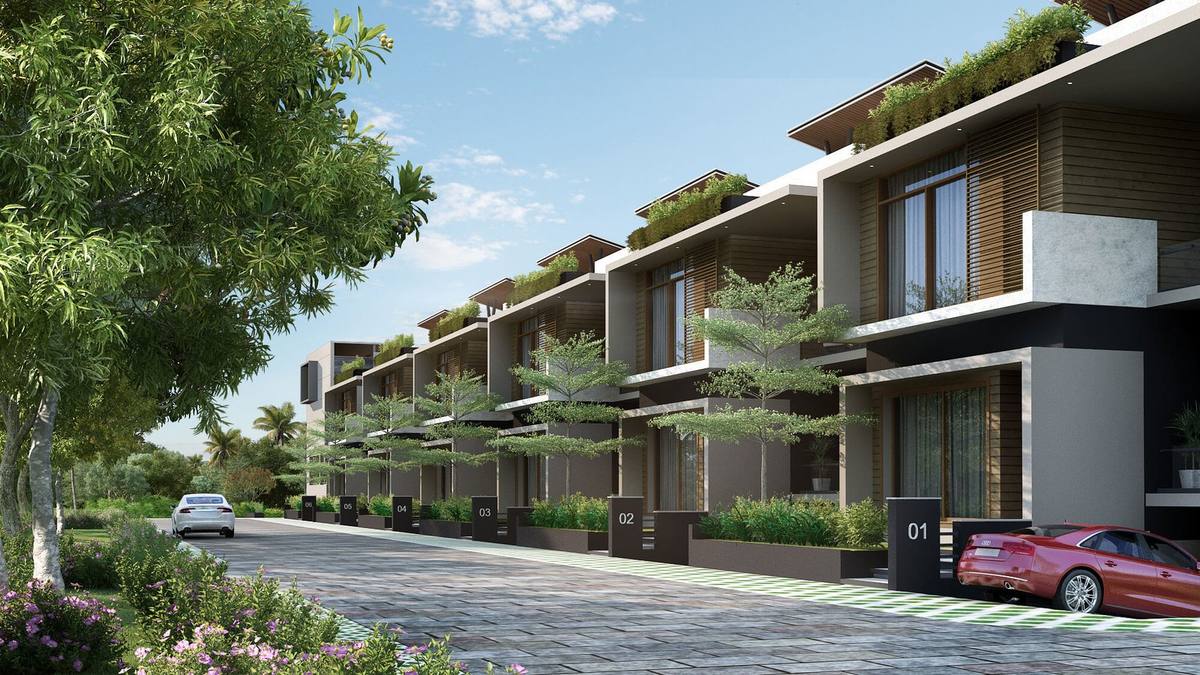
Urban Serenity Villas by Fynday Homes, Edappally is one of the most compelling examples of a Kochi villa project that has genuinely integrated sustainability into its design DNA — not as a marketing afterthought:
- Solar Infrastructure: Pre-installed 5 kW solar PV system per villa with KSEB net metering compatibility. Each villa is designed to offset 60–80% of typical electricity consumption.
- Rainwater Harvesting: Comprehensive RWH system with first-flush filters, underground storage sumps, and dedicated recharge pits. Complies with Kochi Municipal Corporation RWH mandates.
- 40% Open Green Spaces: The layout dedicates 40% of the 1.83 acre site to landscaped green areas planted with native Kerala species — reducing irrigation needs and providing natural cooling through evapotranspiration.
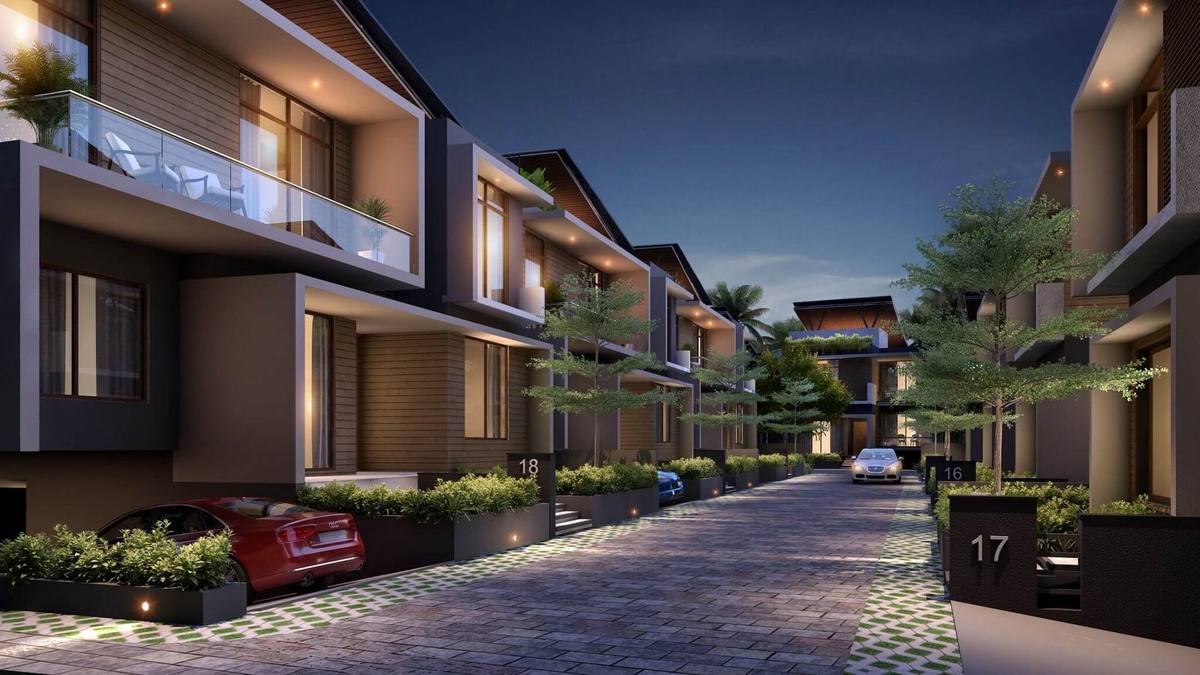
- Perforated Pavers: All driveways and walkways use permeable/perforated pavers that allow rainwater to percolate rather than running off.
- EV Charging Points: Pre-installed EV charging infrastructure for each villa — eliminating the need for costly after-market installation.
- Smart Solar Integration: Smart home app integrates solar generation monitoring, letting villa owners track their energy production and savings in real time.
- IGBC Gold Target: The project targets IGBC Green Homes Gold certification — placing it among the top-tier green residential projects in Kerala.
- RERA Approved: K-RERA/PRJ/ERN/194/2023 — fully compliant with all Kerala regulatory requirements.
The project is particularly notable for its location in Edappally — one of Kochi's most flood-resilient elevated areas, adjacent to the metro, Lulu Mall, and Amrita Hospital. The combination of a genuinely green design, a highly connected location, and a trusted developer makes it a benchmark for sustainable villa development in Kochi.
Enquire about Urban Serenity Villas or call us at +91 8281484494 to discuss sustainability features and arrange a site visit.
Eco Villa Buyer Checklist: 15 Questions to Ask Before Purchase
Run through these 15 questions before signing any agreement for an eco-villa in Kochi:
- 1. Is the project IGBC Green Homes or GRIHA certified? Ask for the certificate number and verify it on igbc.in or teriin.org.
- 2. What is the solar PV system size, and is net metering included? Confirm KSEB approval for grid connection.
- 3. Does the RWH system include both storage and groundwater recharge? Storage alone does not address flood mitigation or groundwater depletion.
- 4. What is the building's orientation? North-South orientation for the longest facade is optimal for Kochi's latitude.
- 5. Are AAC blocks or insulated wall systems used? Thermal insulation significantly reduces cooling costs in summer.
- 6. Is there a reflective roof coating or cool roof system? Roof heat is the largest single source of heat gain in Kerala villas.
- 7. Are low-VOC paints used as standard throughout the villa? Confirm this in writing — not just for show homes.
- 8. Is the plywood formaldehyde-free (E0 grade)? This should be specified for all kitchen cabinets, wardrobes, and furniture built into the structure.
- 9. Are EV charging points pre-installed or just conduit预留? Pre-installed points are ready to use. Conduit预留 means additional installation cost will be incurred.
- 10. What is the projected electricity bill for a typical villa in this project? A credible developer should have actual or modelled data.
- 11. What is the project's flood resilience record and site drainage design? Ask for the stormwater management plan. Post-2018, this is non-negotiable.
- 12. What native/indigenous plant species are used in landscaping? Imported ornamental grasses require constant watering — a hidden cost and environmental burden.
- 13. What is the waste management system? Does the project include on-site organic waste composting?
- 14. Is the solar system owned outright or leased? Leased solar systems (common in some markets) mean you do not own the panels and may face restrictions when selling.
- 15. What is the green premium over a conventional villa in the same locality? If the premium is negligible, question whether genuine green features are actually included — or whether it is greenwashing.
Frequently Asked Questions
Do eco-friendly villas in Kochi really save money on electricity?
Yes. A well-designed eco villa with a 5 kW rooftop solar system, LED lighting, and cross-ventilation design can reduce electricity bills by 60–80% compared to a conventional villa of the same size. Monthly savings of Rs 6,000–15,000 are typical. Over a 20-year ownership period, lifetime savings can exceed Rs 15–20 lakhs — often more than the green premium itself.
Is Kochi's climate suitable for solar power?
Absolutely. Kerala receives 300+ sunny days per year with solar irradiance of 5–6 kWh per sq m per day — among the highest in India. A 5 kW solar system in Kochi generates approximately 600–750 kWh per month, making rooftop solar not just viable but highly profitable under KSEB's net metering scheme.
What green certification should I look for in a Kochi villa?
IGBC Green Homes certification is India's most recognized residential green building standard. For international credibility (particularly useful for NRI buyers), Edge certification from the IFC is also valuable. Always verify the certificate number directly on the issuing body's website — do not rely on developer marketing materials alone.
How does an eco villa perform during Kerala's monsoon floods?
An eco villa with proper stormwater management — perforated pavers, groundwater recharge pits, and adequate plot drainage — is significantly more flood-resilient than a conventional villa. Combined with elevated site grading and proper rainwater channeling, these features reduce flood risk substantially. Edappally and several other Kochi localities where premium villas are located are also among the highest elevation areas in the city, adding another layer of flood resilience.
Can I add eco features to a conventional villa after purchase?
Some features — like solar PV systems, low-VOC paints, and EV charging points — can be added after purchase. Others, like building orientation, structural thermal mass, and integrated RWH systems, are most effective when designed into the construction from the start. If budget is a constraint, prioritize a solar PV system (best ROI) and low-VOC paints (highest health impact) for post-purchase installation.
Are there government incentives for buying or building eco-villas in Kerala?
Yes. The central government's PM Surya Ghar scheme provides up to Rs 1,20,000 in subsidy for rooftop solar installations up to 4 kW for residential properties. Additionally, KSEB's net metering policy allows villa owners to earn credits for excess solar power exported to the grid. State government policies for green buildings change periodically — check with the Kerala Renewable Energy Development Agency (KREDCO) for current incentives.
Ready to Buy a Truly Eco-Friendly Villa in Kochi?
Urban Serenity Villas by Fynday Homes in Edappally offers IGBC Gold-targeted sustainable villas with solar power, rainwater harvesting, EV charging, and 40% green open spaces. RERA approved. Book a site visit to experience sustainable luxury living first-hand.